Uline Shipping Boxes Priced by Flute and Quantity

Flute Type Drives More Cost Than Size
The single decision that moves your per-box cost more than any dimension is whether you buy BC-flute single-wall or B/E double-wall corrugated. A 12 by 12 by 8 inch single-wall box from Uline runs roughly forty to fifty-five cents per unit at a two-hundred-box order. The same footprint in double-wall sits around ninety cents to one dollar fifteen. That is not a rounding difference; across five hundred boxes a week it is three hundred to seven hundred dollars of material you are paying for whether or not the contents need it.
The rule that keeps fulfillment managers up at night: single-wall BC flute handles up to about twenty-five pounds of product with a one-inch wall. Double-wall B/E gives you roughly a two-inch effective wall and supports forty to sixty pounds before the bottom plate creases. If your average order weighs under twelve pounds and your peak is under twenty, single-wall is doing the job. Push past twenty-five pounds consistently and the return-rate cost of a crushed box will exceed the savings you got by skipping double-wall.
One nuance Uline buries in the product spec: their BC-flute boxes use a 200 ECT medium with 150 ECT liners, while the B/E double-wall runs 300 ECT outer and inner with a 250 ECT core. If you are shipping fragile items through a regional carrier that transfers twice, that extra hundred points of edge crush strength is not marketing fluff; it is the difference between a box that arrives with a dent and one that splits at the seam.
Per-Unit Pricing at Real Order Quantities
Uline prices corrugated boxes in volume tiers, and the jumps are not linear. A standard 10 by 8 by 6 inch single-wall box costs approximately eighty-five cents each when you order twenty-five units. At one hundred units it drops to sixty-two cents. At two hundred it is fifty-one cents. At five hundred it sits near forty-four cents. The first tier to second-tier drop saves you about twenty-seven percent; the third to fourth tier saves another fourteen percent. If your weekly volume hovers around seventy-five boxes, you are paying the one-hundred-unit price whether you order seventy-five or one hundred, so the rational move is to pull two extra weeks of inventory into that week and bank the savings.
The free-freight threshold matters more than most people model. Uline ships ground freight on box orders over roughly forty-nine dollars after any applicable discounts. A twenty-five-box order at eighty-five cents is twenty-one dollars in product, which means you are looking at a six to nine dollar LTL or parcel surcharge that wipes out the per-unit savings. Order a hundred boxes and the product cost clears the threshold with room for tape and void fill in the same shipment, eliminating the freight line entirely.
One practical detail: Uline does not break pallets. A full pallet of 12-by-12-by-8 single-wall runs about four thousand boxes at roughly thirty-eight cents each, but the minimum is the full pallet or you ship it as a mixed LTL load and pay two hundred to three hundred dollars in freight. For operations under one thousand boxes a month, ordering in two-hundred to five-hundred unit lots on their parcel-and-ground tier is almost always cheaper than trying to rationalize a pallet.
Carrier Size Thresholds Change Your Box Choice
UPS and FedEx both switch from residential ground rate to dimensional-weight pricing the moment your box exceeds fourteen by eleven by twelve inches, or when the volumetric weight (length times width times height divided by 139 for UPS, 170 for FedEx) exceeds the actual weight. A 12-by-12-by-8 Uline box has a UPS volumetric weight of about 8.4 pounds. If your product weighs four pounds, you are being charged as if it weighs eight and a half. A 10-by-8-by-6 box drops that to 3.5 cubic feet and a 4.2-pound volumetric rating, which for the same four-pound product means you are no longer in dimensional territory.
This is where the box choice stops being a packaging decision and becomes a rate-card decision. If your average order weighs between three and seven pounds, the 10-by-8-by-6 or the 12-by-10-by-4 Uline sizes keep you under the fourteen-inch longest-side threshold for most carrier zones. The 12-by-12-by-8 box is a trap for light, bulky products: it looks like a reasonable size for a t-shirt and a small accessory, but it pushes you into dimensional billing in every zone beyond Zone 3.
USPS Ground Advantage handles this differently; their pricing steps are tied to weight bands up to fifteen pounds and they do not apply the same dimensional formula below that. If a significant share of your volume is under seven pounds and you are comfortable with a two-to-five-day delivery window, USPS often beats a 12-by-12-by-8 UPS box by forty to sixty cents per package. The box size you choose at Uline should be driven by the carrier matrix you actually use, not by what fits in your mind.
When Uline Beats a Local Box Store
A local office-supply or box store will sell you a 12-by-12-by-8 single-wall box at one dollar fifteen to two dollars each, no volume discount, no freight break. Uline at two hundred units is fifty-one cents on the same box. Even if you add a six-dollar shipping charge because your order dips under the free-freight line, you are still paying roughly fifty-four cents per box. The local store's convenience costs you about one dollar per unit in material, which across four hundred boxes a month is four hundred dollars of margin you gave away for the privilege of not waiting three days for a delivery.
Where the local store still wins: same-day pickup when your line ran out of boxes at eleven a.m. and your next order deadline is at two. Uline's standard ground transit is two to five business days depending on your zone, and their expedited freight surcharge on a partial pallet runs one hundred fifty to two hundred fifty dollars. For a true emergency where you need thirty boxes before the end of shift, the local store at two dollars a box is cheaper than Uline plus expedited freight, which would land you at three to four dollars per unit once you split that freight across thirty boxes.
A third consideration is selection depth. Uline carries roughly forty distinct corrugated box sizes in single-wall and another twenty in double-wall, including half-flap, full-flap, and die-cut mailer styles. A local store typically stocks six to eight sizes. If you are shipping a product with an odd footprint, say a flat panel that is twenty-four inches long but only four inches deep, Uline has a 24-by-18-by-4 or a 20-by-15-by-3 option that will not over-cube your shipment. The local store does not, and you end up buying a 24-by-18-by-12 box and paying dimensional weight on the empty air.
Packing Consumables That Add or Save Hours
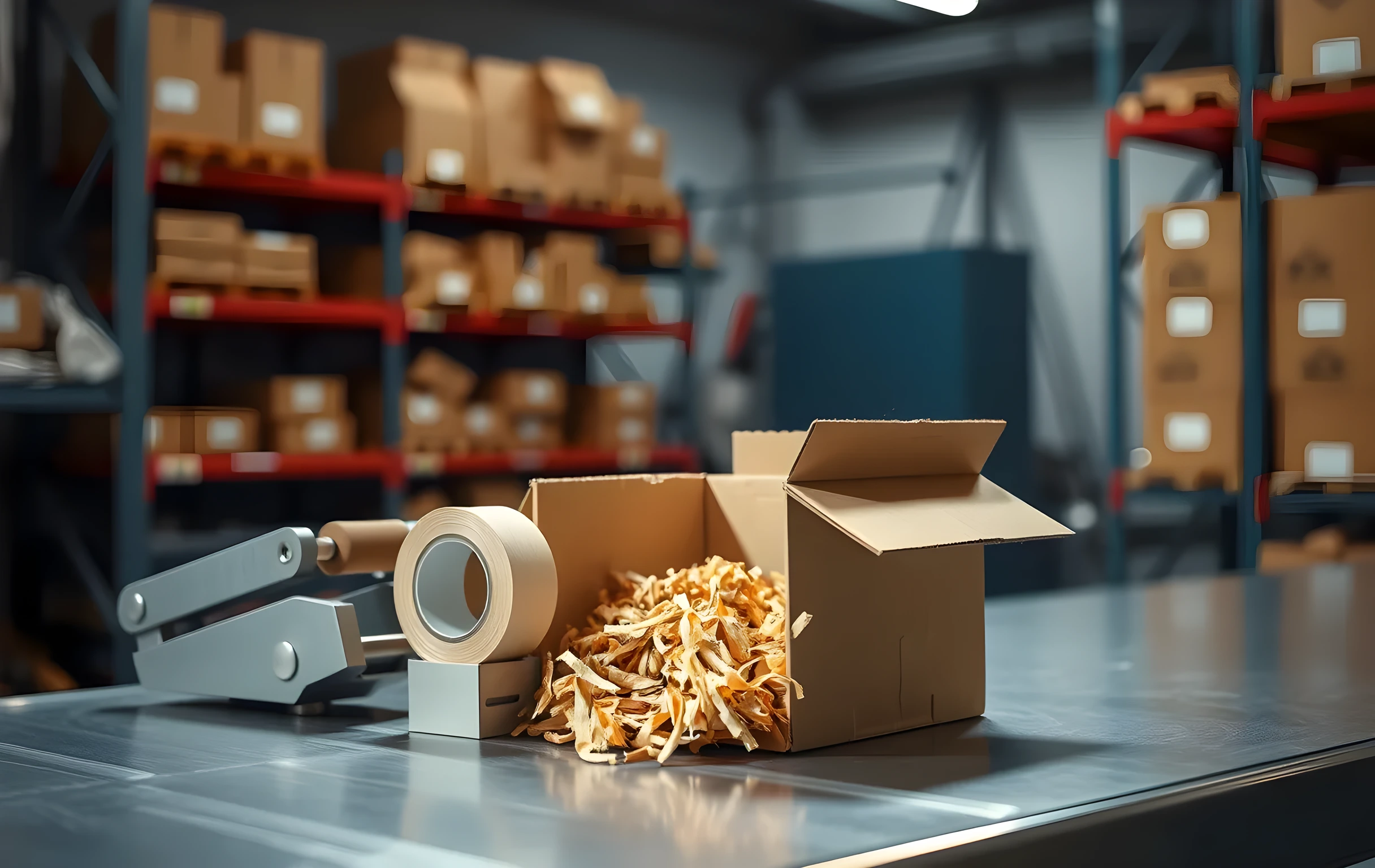
The box is maybe forty percent of your packing cost. The tape, void fill, and labels are the other sixty, and they are where a fulfillment operation loses twenty to forty minutes per shift if the supplies are wrong. Uline sells kraft paper packing tape in two-inch and three-inch widths at roughly three dollars per roll (one hundred feet) at single-roll pricing, dropping to two-fifty at ten rolls. The three-inch width is the one that works with a standard dispenser on a packing line; the two-inch roll is fine for sealing a mailer but forces your packer to make two passes on a twelve-inch seam, adding four seconds per box.
Void fill is where the math gets interesting. Shredded paper rolls cost about eight dollars each and fill roughly one cubic foot of empty space. Air-cushion bags (the inflatable pillow type) run ninety cents to a dollar fifty each but take thirty seconds to inflate and position versus eight seconds to stuff paper. Across a hundred boxes a day, that is twenty-two minutes saved per shift by choosing shredded paper if your product tolerates it. If you are shipping ceramics or glass, the cushion bags are not optional; the return cost of one cracked vase at forty-five dollars replaces a month of air-cushion spend.
Label stock is the quiet line item. Uline sells thermal transfer labels in 4-by-6 and 4-by-3 inch formats at roughly twelve cents per label at two-hundred-label rolls, versus eighteen to twenty-two cents per sheet from a local office store. If your label printer is running eight hundred labels a week, that difference is sixty to eighty dollars a month. Small, but it compounds, and it is the kind of cost that shows up in your cost-per-order number as a fraction of a cent per box until you add up forty weeks.