Small Shipping Container Pricing Tiers and What Each Size Holds
Sizing Up What Actually Fits Inside
A 10-foot container gives you roughly 268 square feet of floor space with an interior width of 7 feet 10 inches and a clear height of about 7 feet 9 inches. That fits one standard pallet lane with clearance on both sides, or two narrow aisles if you are running a compact pick-and-pack station. For an online store doing 40 to 80 orders per day, that is enough for overflow SKUs, return staging, and a single packing table without feeling like you are working in a closet.
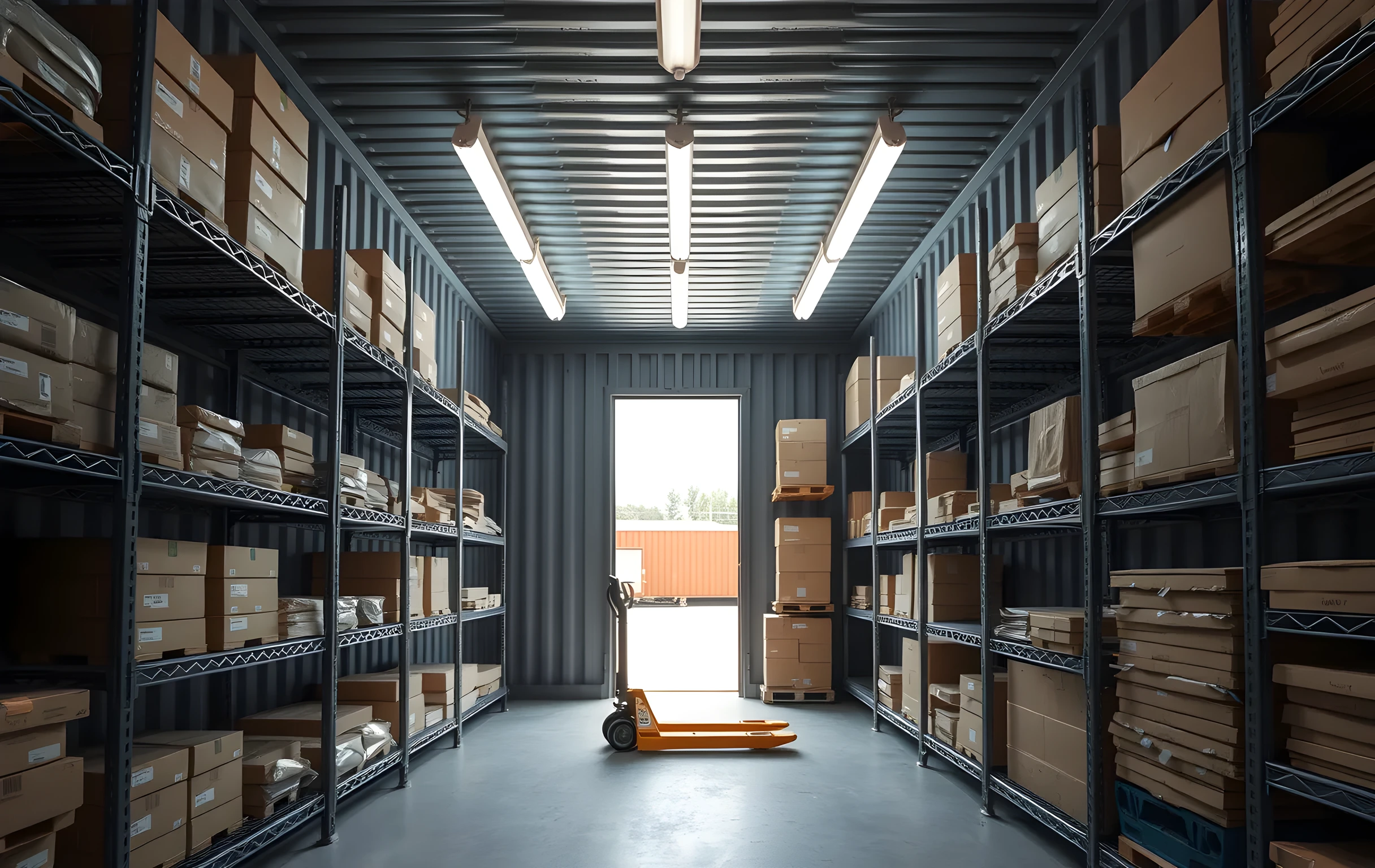
A 20-foot container doubles the floor area to approximately 570 square feet while keeping the same 7-foot-10-inch width. The extra length changes the workflow: you can run two full pallet lanes end-to-end, add a racking system along one wall, and still leave a three-foot clearance at the door for a hand truck or compact pallet jack to swing through. If your operation is past the point where one person can pick, pack, and stage in a single 10-footer, the 20-footer is where the cost-per-order math stops punishing you.
A practical rule of thumb we see operators use: count your active SKUs, multiply by the average cube per unit, then add 30 percent for staging and return flow. If that number exceeds 18,000 cubic feet, a 20-footer is your minimum. Below that, a 10-footer keeps your fixed costs down without sacrificing pick density.
New Versus Used: The Real Price Gap
A new one-trip 10-foot container in the current market runs $3,800 to $5,200 depending on region and whether it is a standard or high-cube build. A comparable used unit with light rust and a replaced door seal drops to $2,400 to $3,600. The 20-foot tier sits at $4,900 to $8,400 new and $3,500 to $5,800 for a clean one-trip used unit. These are door-delivery-adjacent prices; the freight leg is not included and will add more than you think.
The trade-off is not just cosmetic. A new container comes with a manufacturer warranty on the shell, typically one to five years depending on the seller, and guarantees that the floor is intact, the corners are square, and there is no hidden water damage in the corrugation. A used unit at $2,600 might save you $2,400 up front but cost you $1,200 to $2,000 in a new floor if it has moisture rot, plus the labor to install it. When you are measuring hours of downtime while a crew replaces decking, that savings evaporates.
If your use case is external storage where the container sits sealed for months at a time, a used unit is defensible. If people are walking in daily to pull inventory, pack orders, and run a label printer, budget for new or top-grade one-trip condition. The $2,000 premium buys you three to five years of not worrying about a leak at 2 a.m. during a rain event.
Delivery and Site Prep You Did Not Budget
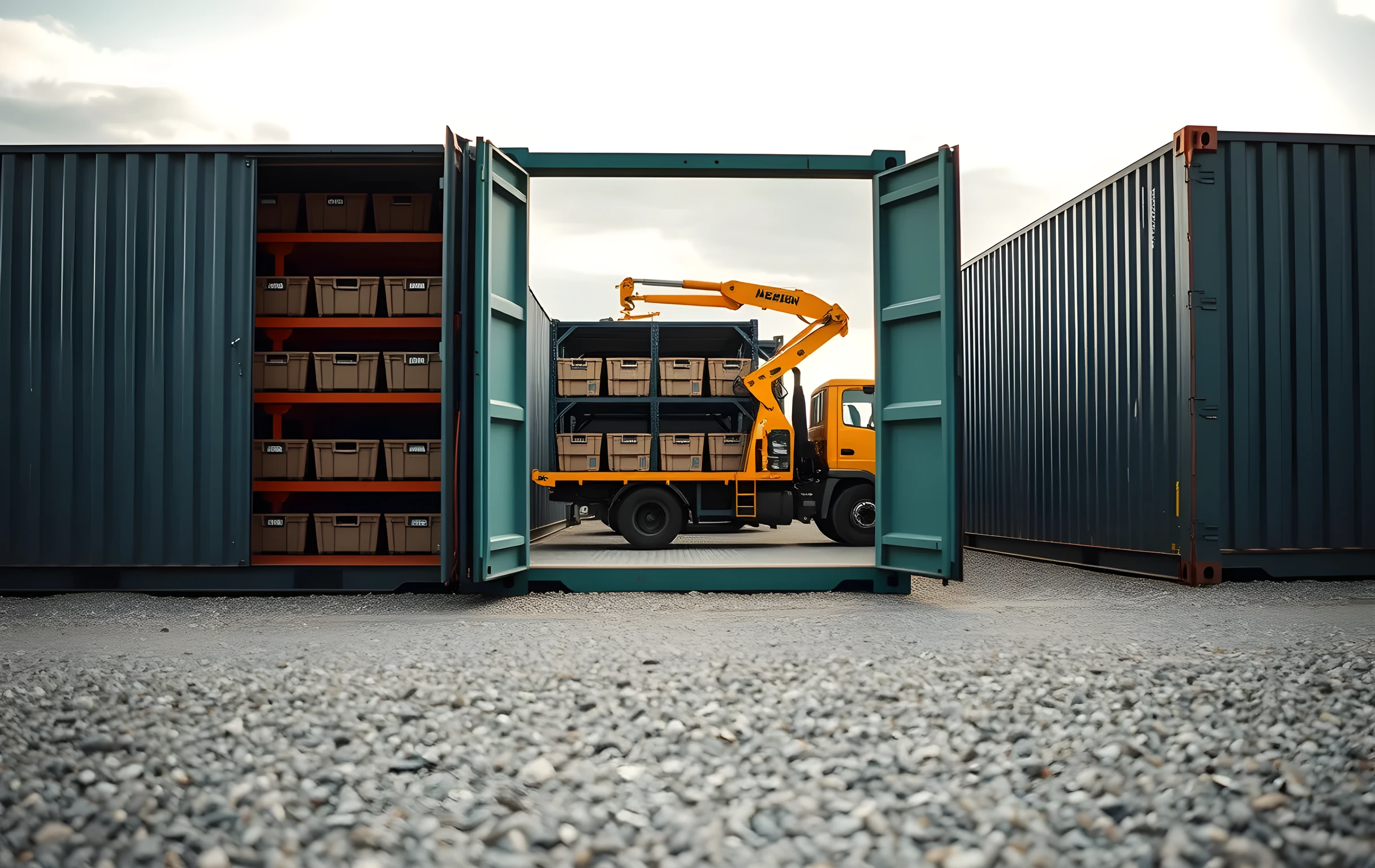
The sticker price on a container is the shell. A flatbed with a hydraulic crane or over-the-road lift gets a 10-footer onto your site for $450 to $900 within a 30-mile radius, but the moment you are past 100 miles or in a rural corridor, that number climbs to $1,200 to $1,800. A 20-footer is heavier and needs a different rig; expect $600 to $1,500 for local delivery and up to $2,200 beyond it. These are 2024-2025 ranges in the continental United States and will shift with diesel prices.
Before the truck arrives, you need a level pad. That means either 3 to 6 inches of compacted gravel or 4 inches of concrete slab, sized to the container footprint plus an 18-inch perimeter for drainage. For a 20-footer, that is roughly 70 by 24 feet of prep area. Gravel install runs $2,500 to $4,500 depending on soil and access; concrete runs $6,000 to $11,000. If your site already has a level pad from a prior structure, you skip this line item entirely.
Permits are the variable that surprises people. Most municipalities require at minimum a placement permit and, in many cases, a building or accessory-structure permit if the container is connected to utilities or occupied for more than a few hours daily. Expect $200 to $1,500 in fees and one to four weeks of processing time. Factor that lead time into your go-live date before you sign a delivery slot.
Modifications That Change the Operating Math
A bare container is 26 gauge steel with no insulation, no electrical, and no lighting. To make it a functioning pick-and-pack space you need at minimum: a 20-amp circuit or a small sub-panel if you are running LED strips, a label printer, and a scanner; 2-inch rigid foam or spray-foam insulation on walls and ceiling to keep interior temps between 55 and 85 degrees year-round; and a finished floor system over the marine plywood. That package runs $3,500 to $7,000 for a 10-footer and $5,500 to $11,000 for a 20-footer, installed.
The insulation question is where people cut corners and regret it. A bare steel shell in July holds the ambient temperature of the sun-baked ground; inside can hit 120 degrees by midday. For electronics, cosmetics, or any SKU with a heat sensitivity, that is a quality-control problem that shows up as customer returns. Two inches of closed-cell foam on all four walls and the ceiling brings you into a workable range for $1,800 to $3,200 in material plus labor.
Electrical is where the cost scales with your equipment list. A single circuit for lighting and one outlet is an afternoon job at $600 to $1,000. If you are running a small UPS, a thermal label printer on a dedicated circuit, Wi-Fi access point, and possibly a dehumidifier or mini-split for climate control, you are looking at a 200-amp sub-panel feed and $2,500 to $4,500 in wiring and labor. Get the electrical scope locked before the shell arrives, because retrofitting conduit through an insulated wall costs double.
Where a Container Beats a Lease Bay
A single bay in a shared e-commerce warehouse or flex space runs $12 to $28 per square foot per month depending on metro and amenities. That is $3,200 to $7,500 per month for the 268 square feet inside a 10-footer, or $6,800 to $16,000 per month for a 20-footer. A purchased container at $4,500 to $8,400 new, plus $3,000 to $7,000 in mods and delivery, pays for itself against lease in four to nine months of avoided rent. After that, the only recurring costs are electricity and a modest insurance premium.
The operational argument is not just cost. When your inventory lives in a container on your own property or on land you control, your pick path is fixed. You design the rack layout once, your operators learn the flow in two shifts, and there is no shared loading dock where a third party is unloading pallets while you are trying to stage a carrier pickup. For stores doing 100 to 500 orders per day, that control over the last 20 feet of the pick path shaves 3 to 8 minutes off average order cycle time, which compounds into meaningful labor savings by the end of a month.
The findability piece matters more than it sounds. In a shared facility, your SKUs sit between other companies' stock, and a mislabeled bin or a reorganized aisle can cost you an entire pick. In a single-tenant container, every shelf face is yours, every label is in the position you set it, and the total SKU count is small enough that a new hire can learn the map in one afternoon. That reduces mis-picks, which reduces returns, which reduces support tickets. It is a small box, but the workflow inside it is entirely yours to optimize.