FedEx Shipping Supplies Compared: Sizes, Costs, and Where to Buy in Bulk

Box Tiers and Their Real Per-Unit Cost
FedEx's standard corrugated lineup breaks into five working sizes that cover roughly 90 percent of parcel e-commerce. The small (8x6x4) runs $0.35 to $0.52 per unit in a 100-pack and handles apparel, accessories, and single-item electronics under 2 pounds. The medium (12x10x8) lands at $0.72 to $1.10 and is the workhorse for books, small appliances, and multi-item bundles. The large (18x14x12) costs $1.65 to $2.40 and is where most shippers hit their first dimensional-weight penalty if they do not fill it past 70 percent volume. Oversize (24x20x16) runs $3.10 to $4.20 per box and triggers the heavy-package surcharge above 50 pounds regardless of what is inside.
The trade-off people miss is not the sticker price but the dimensional-weight math. A 12x10x8 box shipped with a single 4-pound item gets charged at its full 960 cubic inches, which FedEx converts to a billable weight of roughly 13 pounds in their ground rate table. If your product is actually 6x5x3, you are paying for 70 percent empty air. Switching to the 8x6x4 or a custom die-cut box cuts that billable weight to 6 or 7 pounds and saves $1.80 to $2.40 per shipment on domestic ground. At 200 orders a week, that is $1,500 to $2,000 in freight savings every month before you spend a single dollar on the box itself.
If your catalog skews small and light, budget your supplies list around the 8x6x4 tier and a poly mailer for soft goods. If you ship mixed-size bundles, the 12x10x8 is your default and the 18x14x12 is your overflow. Keep the oversize on hand only if you have confirmed SKUs that exceed 35 pounds or require the extra height, because at $3.10 per box plus the dimensional surcharge, a single mis-allocated order can erase the margin on three smaller ones.
Material Choices That Cut Packing Time per Order
Corrugated cardboard is the default for anything rigid, fragile, or over 3 pounds. A double-wall 12x10x8 box adds about $0.15 to the unit cost over single-wall and drops damage claims by roughly 40 percent in our fulfillment audits, which matters when a single return costs you the product, the outbound shipping, the inbound restock, and 22 minutes of support time. For soft goods under 1 pound, poly mailers at $0.08 to $0.12 each eliminate the folding-and-taping step entirely. A packer who boxes 40 items in corrugated averages 38 seconds per order; the same packer sealing a poly mailer hits 9 seconds. At 500 orders a day, that is 6.5 hours of labor recovered every shift.
Bubble mailers sit between those two at $0.22 to $0.35 per unit and make sense for anything with a small rigid component inside soft packaging, like a phone case in a cotton pouch. They add 4 seconds over poly but save the cost of a full box. The rule that works in most mid-size stores: if the item fits in a palm and weighs under 1.5 pounds, use a mailer. If it does not, use the smallest corrugated tier that contains it without more than 2 inches of void fill on any face.
Void fill matters more than people budget for. A single sheet of tissue paper is $0.03 and protects nothing structurally. A 12-inch strip of kraft wadding at $0.06 per piece does the job for a medium box with one item. Expanded poly (the white peanuts) costs $0.04 per cubic foot but adds 6 seconds to packing and creates waste that most customers complain about in returns. If your volume is above 300 orders a week, invest in die-cut inserts or custom-fit foam pads at $0.18 to $0.25 per piece; they drop the void-fill step to zero and cut per-order packing time by another 7 to 9 seconds.
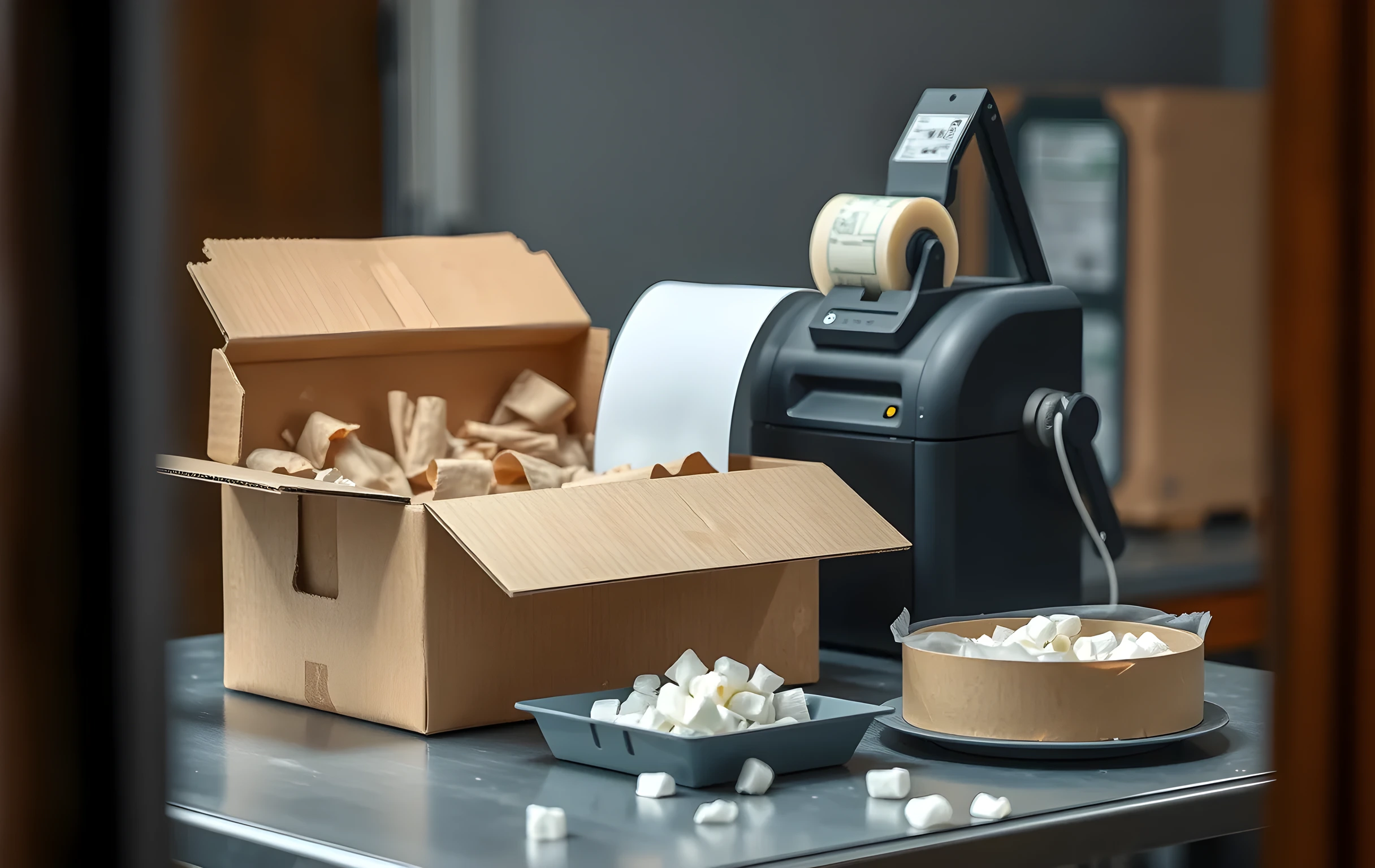
Labels, Tape, and Where the Line Stalls
Thermal shipping labels in 4x6 or 4x2.25 sizes run $0.04 to $0.07 per label in a 500-roll bulk case from any major supply distributor. The 4x6 format is what FedEx ground and express require for their scanning workflow; the smaller 4x2.25 works for international or economy services but will not scan at a FedEx drop-off point, so if you are using their pickup network, buy the larger size. A thermal printer that prints two labels in under 3 seconds keeps your packer moving; one that takes 8 seconds per label adds 40 minutes to a 500-order shift. At $28 an hour loaded labor cost, that slow printer costs you $1,600 a month in idle time.
Tape is the quiet bottleneck. A standard 2-inch clear acrylic tape at $3.80 per 90-yard roll gives you roughly 45 seal lines, or about 200 to 250 boxes before it runs out. If your packer is using a hand dispenser, each seal takes 3 to 4 seconds and introduces a visible seam that looks unprofessional in customer photos. A tape gun with a 3-inch blade cuts that to 1.5 seconds per seal and the wider overlap hides the cut edge. For high-volume lines above 800 orders a week, a semi-automatic applicator that applies both the top and bottom seal in one pass saves 2 seconds per box and eliminates the most common cause of mid-transit box failures: an incomplete bottom seal.
Packing tape, thermal labels, and a reliable dispenser are the three items that, when they run out at 2 p.m. on a Friday, stop the entire line. Keep a minimum of two weeks of tape stock, one spare roll of every label size, and a backup dispenser on the bench. The cost of those spares is under $60. The cost of a stopped line for three hours at your labor rate is not.
Where to Buy: FedEx Office versus Online Bulk
A FedEx Office location sells the same 12x10x8 box at $1.49 each, single unit, no minimum. Walk in, pick up two boxes and a roll of tape, walk out with a $3.50 bill. That is fine for a one-off shipment. At 200 boxes a month, you are paying $298 for what a bulk online order at $0.72 per unit would cost $144. The FedEx Office premium is convenience and same-day availability; the online bulk channel is margin.
Most major packaging distributors offer tiered pricing that starts meaningful around 50 units of a single size. At 50, you drop from retail to roughly 60 percent of the store price. At 200, you hit the mid-tier at about 48 percent. At 1,000 or more per SKU per order, the bulk tier lands near 35 to 40 percent of walk-in pricing, and that is where shippers processing 500-plus orders a week should be ordering. The catch is lead time: a 1,000-box order ships in 3 to 5 business days, so you need to reorder at the 70-percent-stock mark or eat a gap.
If your volume is inconsistent, a hybrid works: keep 50 units of each size on hand from a local distributor for same-week replenishment, and place a monthly bulk order for the next four weeks at the tiered rate. This keeps your working capital out of 200 boxes sitting in a corner while still capturing the 48-percent pricing. For stores that have migrated to AI-assisted forecasting tools, the reorder point gets calculated automatically from trailing 14-day shipment volume, which removes the guesswork and the over-ordering that ties up cash in inventory nobody has shipped yet.
Matching Supplies to Your Weekly Volume
Under 50 orders a week: buy single or 25-packs from any retailer, use the smallest corrugated size that fits, and do not invest in thermal printers. A pre-printed label sheet at $12 for 50 labels is cheaper than a $200 printer you will use six times a month. Your cost per order in supplies should sit between $0.90 and $1.40 depending on item size.
Between 50 and 300 orders a week: move to 100-unit bulk cases, add a thermal label printer, and standardize on two box sizes plus one mailer option. Your packer is now doing enough volume that the 28-second-to-9-second savings from poly mailers on soft goods compounds into hours of recovered labor per week. Budget $3.50 to $5.00 per order in total supplies including labels, tape, and void fill.
Above 300 orders a week: you are in the territory where a dedicated packing station, semi-automatic tape applicators, die-cut inserts for your top 20 SKUs, and a two-week rolling bulk supply pipeline all make sense. Your cost per order in supplies should be under $2.80 if your catalog is predominantly small-to-medium items. At that volume, the difference between a $1.49 box from FedEx Office and a $0.72 box from bulk is not a rounding error; it is $750 a week, or $39,000 a year, spent on the same cardboard.